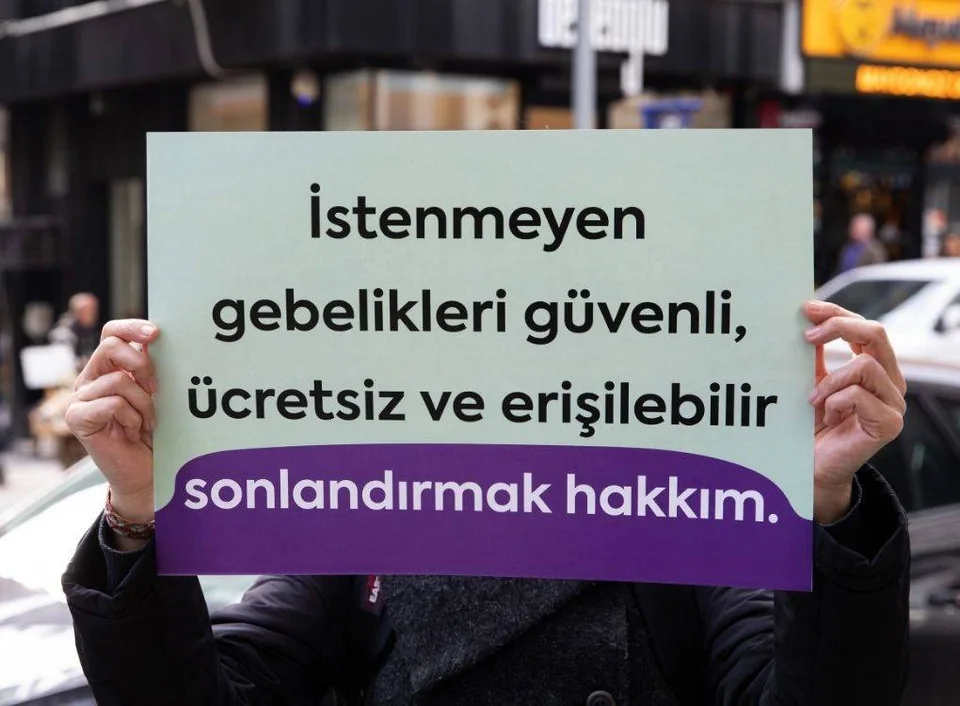
Abortion, which is legal until the 10th week in Turkey, is not actually performed in public hospitals for reasons such as "there is no doctor", "it is unethical", "institutional policy".
Interviews held in both public and private clinics in five provinces draw attention to the difficulties of women having an abortion on demand. The cost of having an abortion in private clinics is up to 45 thousand liras. This number varies depending on the city and the doctor's experience.
According to the World Health Organization (WHO), approximately 73 million abortions occur every year in the world, and 45 percent of them are performed in unsafe conditions. For this reason, approximately 39 thousand women lose their lives every year, while millions of women face permanent health problems.
In Turkey, complaints that abortion is not performed in public hospitals, although it is a legal right, are frequently brought to the agenda. After then-Prime Minister Recep Tayyip Erdoğan said in a speech in 2012 that he considered abortion as murder, anti-abortion practices became systematic. To date, parliamentary questions have been submitted to the Turkish Grand National Assembly regarding the de facto ban, and it has been reported many times. The latest study we conducted revealed no change in the situation.
We received a rejection response from most of the public hospitals in Istanbul, Ankara, Konya, Aantep and Erzurum that we contacted with an abortion request. Some hospitals openly justified this situation as “institutional policy.”
However, in Turkey, abortion is legal for married women with the consent of the spouse and until the 10th week, in accordance with the Population Planning Law No. 2827. Health professionals point out that women are turning to under-the-counter abortion methods due to the de facto ban and remind that safe abortion is every woman's fundamental right to health.
With the Presidential Decree published in the Official Gazette on December 25, 2024, the Population Policies Board was established within the Ministry of Family and Social Services. The board, chaired by the Vice President, consists of relevant ministers and institution representatives and aims to develop policies and projects towards falling birth rates.
The government continued these policies by declaring 2025 as the "Year of the Family". In this context, steps such as "Normal Birth Action Plan" and "Family Institutes" were taken. President and AKP Chairman Recep Tayyip Erdoğan said, "Unfortunately, we are at 1.7 in the population growth rate. This is suicide... At least three children, why not four or five?" His words made the government's approach to abortion even more visible.
Doctor: Abortion is almost banned
The Ministry of Health has not published detailed data on the reasons for abortion since 2010. Current statistics, broken down by pregnancies resulting from sexual assault, elective abortions, or medical obligations related to maternal health, are not shared with the public. However, in a study conducted by Kadir Has University Gender and Women's Studies Center in 2016, it was determined that 78 percent of 431 public hospitals across Turkey did not provide abortion services on demand, and 11.8 percent did not provide any abortion services.
A physician we interviewed at a public hospital in Istanbul, who did not want to give his name due to job security reasons, said, "Abortion is almost banned. We are not even able to install a spiral. The coil used to be a free and accessible method of contraception, but now it has become paid." Pointing out that some units have been established under the name of "family planning" in state hospitals, the doctor also explained that despite legal regulations, the practice varies depending on the hospital: "Normally, optional abortion is possible up to 10 weeks. However, in practice, this right is often not exercised. Which physician is on duty in the institution where the woman will have the abortion that day and the physician's personal approach are decisive. Some doctors do not perform abortions for ideological or personal reasons."
Another doctor, also in Istanbul but working in a private clinic, said that abortions are performed up to 10 weeks and the fee varies depending on the district, hospital and doctor's experience.
If you pay in cash, no record will be opened
An official at a public hospital in Ankara confirmed that many doctors do not perform abortions: "The doctor decides whether an abortion can be performed or not. Doctors do not want to do it."
A doctor at a private clinic in Çankaya stated that abortion can be performed up to 10 weeks, but after the 7th week of pregnancy, the cost increases due to risks. The clinic also gave the following information about the transaction fee: "If your payment is in cash, we do not register patients or process them into the system."
Official marriage is required
The situation is not much different in the public hospital in Konya. The answer we received was as follows: "We cannot perform abortions in this state hospital, we do not perform abortions on demand. We do not perform abortions even if you are married."
The response from another public hospital in the city is more striking: "We have a legal marriage requirement for abortion. We know it is written in the law, but if our doctor wishes, he will impose a marriage requirement." It was stated that there was a doctor at the private hospital interviewed in Konya and that he did not choose to perform an abortion. The second private hospital we interviewed said that they offer abortion services on demand and made the following suggestion for privacy: "When payment is made by credit card, it is recorded in the system, but we can write another disease in the records."
While a public hospital in Antep clearly stated that they do not perform elective abortions, an employee of a private clinic said that the procedure fee varies between 40-45 thousand liras, a file is not opened and the procedure is not recorded.
The situation was not much different in Kars. Abortion services were not provided at the state hospital and the decision depended entirely on the doctor's opinion. The response of a private hospital in the province was similar: "We do not perform elective abortion in our hospital. This is the procedure. Even if you are married and your spouse wants it, we do not do it. We do not perform the procedure on living pregnancies, we do it on stillborn pregnancies."
"Being recorded is worrying."
One of the concerns of women applying for abortion is being recorded. M.C is one of those names. That's why she preferred a private clinic instead of a public hospital: "They don't question you when you go to a private hospital. Being a woman in a public hospital is like an exam in itself. I didn't want my abortion record to be recorded and for doctors from other departments to see it. Being asked questions like 'Are you a girl?' is already heavy enough."
Emphasizing that whether to give birth or not is a very personal decision, M.C. reacted to the fact that everyone sees themselves as having the right to have a say in this matter: "It is easy to say 'Give birth to a child'. Will you raise them? Will you ensure their safety?"
(EMK)