ISTANBUL - "Amnesty" comes to the agenda before almost every general election in Turkey. During election times, political parties take a stand for or against a possible general amnesty declaration; The public can also have expectations depending on the discourse. In fact, throughout the history of the Republic, amnesty has been a generally discussed issue among the public.
Although the scope has varied since 1921, a total of 52 amnesty laws have been enacted, 7 of which are general. General amnesty was declared seven times, in 1922, 1923, 1933, 1960, 1963, 1966 and 1974.
DIFFERENT REGULATIONS WERE IMPLEMENTED WITH GENERAL AMNESTY
In the first general amnesty declared in Turkey in 1922, the remaining sentences of prisoners who completed two-thirds of their sentences were pardoned.
In the second general amnesty in 1923, half of the sentences imposed for crimes committed until October 29, 1923 were amnestied.
In the third general amnesty declared on October 26, 1933, on the occasion of the 10th anniversary of the founding of the Republic, prosecution was not carried out against those who were sentenced to less than five years, and the sentences of those whose sentences exceeded three years were reduced.
After a long time, a new general amnesty law was enacted on 26 October 1960, following the 27 May coup. The law stipulates that no prosecution will be made for crimes arising from negligence and for penalties that imprison the liberty with a maximum limit not exceeding five years. In addition, one third of the sentences exceeding five years were reduced, but it was ruled that this period could not be less than five years.
REDUCTIONS WERE APPLIED IN THE PENALTIES OF THOSE WHO WERE EXECUTED IN THE SEVENTH GENERAL WEEK
With another general amnesty law enacted on February 23, 1963, amnesty was provided for prison sentences not exceeding five years. Penalties were reduced at various rates and some crimes and penalties were excluded from the scope. With the general amnesty law on August 3, 1966, similar regulations were introduced with the amnesty in 1963 and sentence reductions were applied to prisoners.
In the general amnesty issued on the occasion of the 50th anniversary of the proclamation of the Republic, sentences with an upper limit of not exceeding 12 years were directly pardoned, including those sentenced under Articles 141, 142, 146 and 163 of the Turkish Penal Code. The sentences of those who were executed were also reduced.
THE NUMBER OF THOSE RELEASED IN THE 'RAHŞAN AMNESTY' EXCEEDED 45 THOUSAND
On December 22, 2000, "conditional release" was applied for the second time with a general amnesty, known as the "Rahşan Amnesty". The prison population dropped from 70 thousand to 40 thousand. Then, within 3 years, the number of prisoners increased and reached 64 thousand. Conditional Release and Postponement Law No. 4616 covers crimes committed before April 23, 1999. After the law was enacted, more than 23 thousand detainees and convicts in prisons were initially released by taking advantage of the amnesty. In addition; With the decisions of the Constitutional Court, the scope of the law was expanded and the number of those released exceeded 45 thousand.
110 THOUSAND PEOPLE WERE EVACUATED IN THE LAST REGULATION
Finally, due to the pandemic and the density in prisons, the penal execution law was amended on April 15, 2020, and initially 40 thousand people were released, and later a total of 110 thousand people were released. According to Ministry of Justice data, the 1974 general amnesty reduced the number of detainees and convicts in prison from 61 thousand to 24 thousand. With the 1980 coup, the prison population approached 80 thousand, and with the 1991 amnesty it decreased to 25 thousand.
CRIMINAL ORGANIZATION LEADER ÇAKICI WAS ALSO RELEASED
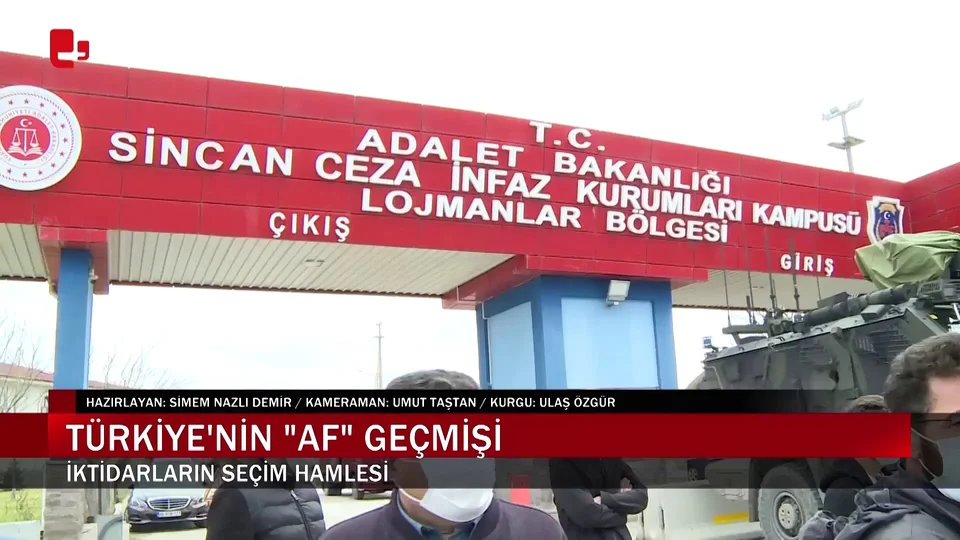
Within the scope of the execution reduction package announced with the initiative of MHP Chairman Devlet Bahçeli, organized crime leader Alaattin Çakıcı was also released from Sincan L Type Penal Institution, where he was convicted, within the scope of the change in the law.
THE POPULATION OF PRISONS CONTINUES TO INCREASE
The conditional release law passed in 2000 was able to reduce the number of detainees and convicts from 70 thousand to 50 thousand. However, the number of detainees and convicts in prison has been increasing steadily since 2006. According to data updated in July this year, more than 360 thousand people remain in prisons.
'THIS SYSTEM WAS NOT APPLIED TO THOSE HELD INSIDE FOR POLITICAL REASONS'
Speaking to Artı Gerçek, Nuray Çevirmen, one of the managers of the Human Rights Association Headquarters, stated that the general amnesty discussions were brought to the agenda for political reasons:
"Discussions on general amnesty are some practices that politically coincide with election times. But in fact, in the context of prisoners, it is obvious that the principle of equality is observed and that there will be no change in the laws or the execution system in which people are imprisoned. There was a "Rahşan Amnesty". Later, some veiled amnesty was made. Thousands of people came out. However, this system was not applied to people who were held in prison for political reasons."
'IT IS AN EMPTY DISCOURSE UNLESS PEOPLE ARE ALLOWED IN WITH ABSTRACT REASONS'
The translator underlined the latest regulation and explained the effects of not observing the principle of equality:
"With the last regulation, a kind of veiled amnesty was issued. Approximately 100,000 prisoners were released. However, the prisoners held within the scope of the TMK still continue to stay in prisons. For this reason, amnesty laws and discourses about amnesty cannot go beyond discourses that will benefit politics and the current government. Therefore, we have demands for the elimination of these principles of inequality, regulation of the execution law, abolition of the TMK, and regulation of the TCK."
Çevirmen also said that general amnesty discussions are ineffective unless a fair trial system is provided:
"Unless the judicial system in Turkey is independent, unless regulations are made in the penal system, and unless the incarceration of people on abstract grounds is eliminated, these discourses of amnesty are empty discourses."
'THE STATE SEES POLITICAL PRISONERS AS A RISK'
Çevirmen said that one of the biggest reasons why the purpose of general amnesty is political is that prisoners who are in prison for political reasons are excluded from the scope of amnesty:
"When we look at all these amnesties, in general, freedom of thought and expression and prisoners who were imprisoned for political reasons were excluded from the scope. Prisoners who could not be released were victimized because the state saw political prisoners as a risk, punished thought, and banned opposition politics. Based on this, all execution regulations and general amnesty are of course political. Considering the times when the amnesties were issued, these practices are the result of the populist politics of the governments."
Çevirmen also touched upon the possibility of judicial prisoners held within the scope of amnesty returning to prison and listed his suggestions for the punishment system:
"In addition, when looking at the amnesty processes, it can be seen from the statistics that there is a return to prisons, especially among criminal prisoners, who commit crimes again. Therefore, policies should be developed and social justice should be ensured in terms of preventing criminal crimes."
'THERE ARE NO PERMANENT SOLUTIONS TO THE PROBLEMS IN PRISONS'
Speaking to Artı Gerçek, Ahmet Kavruk from the Civil Society Association in the Penal System (CİSST) explained the reasons for the general amnesty declared in Turkey:
"General amnesty is undoubtedly a more equal regulation than partial amnesties, called execution regulations, as it covers all prisoners. However, when we look at general amnesties in Turkey's history in detail, we see that they were implemented especially to bring periodic solutions to the density of the prison population. Of course, general amnesty issued from this perspective did not bring permanent solutions to the problems experienced in prisons."
'WE NEED TO ACT WITH COMMON MIND'
Stating that the amnesty announced did not bring a solution to the general problems in prisons, Kavruk said that the problems continued:
"Finally, it should not be forgotten that the general amnesty in the past was not issued independently of the political developments and the political environment in Turkey. The problems experienced by prisoners in prisons are more deep-rooted and concern the public. At this point, the "inside" and the "outside" are not as separate as it seems. In order to bring permanent solutions to the problems experienced in prisons, it is necessary to act with a common mind and ignore non-governmental organizations and people working in the field, especially the prisoners and their relatives.
'THE EXCESS CAPACITY PROBLEM HAS BEEN AVOIDED BY THE EXECUTION REGULATION'
Finally, touching on the execution regulation made in 2023, Kavruk explained the details of the regulation:
"There was an execution regulation on July 15, 2023. It was published in the Official Gazette. Since 2020, there were prisoners on Covid-19 leave during the pandemic period. These prisoners on COVID-19 leave were placed on leave again every two months from 2020 to July 2023. An arrangement was also made in July 2023. Prisoners on COVID-19 leave are entitled to benefit from probation for up to 5 years. was recognized.”
Touching on the capacity problem in prisons in Turkey, which was frequently brought to the agenda in previous processes, Kavruk explained the change in the capacity debate with the new regulation:
"We know that until 4-5 months ago, the total population of prisons was very high and the capacity issue was a matter of public debate. With this execution regulation, this debate has been somewhat prevented."
WHAT IS THE LEGAL REQUIREMENT OF GENERAL AMNESTY DECLARATION IN TURKEY?
In the voting to be held in the Turkish Grand National Assembly to declare a general amnesty in Turkey, the qualified majority of the members, 360 deputies, must approve the proposal. This means that at least 25 MPs from the opposition also vote in favor of amnesty. Therefore, general amnesty cannot be declared by the Presidential decree, the only address for this decision is the Turkish Grand National Assembly.